14 corporate generals, 27 combat battalions, and 22,000 soldiers commanded by Napoleon Bonaparte's brother-in-law, the general captain Victor Emmanuel Leclerc, husband of Pauline Bonaparte, the future emperor's sister.
The main plan of the French army: reestablish slavery, which was abolished by the 1794's Convention, and was effectively restored in Martinique, Guyane and Guadeloupe, the latter being severely repressed.
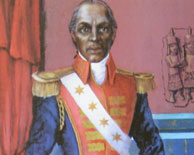
But, in Haiti the former slaves' army commanded by the General Jean-Jacques Dessalines, after the death of Toussaint on April 7, 1803 in Fort-de-Joux, resisted. “Napoleon proposed us this nasty attitude, whether to be enslaved and remainedHaiti's Independence, the First Black Republic in the World, was proclaimed on January 1 st , 1804. The new nation kept the French language as a “plunder of war.”
This military disaster wiped out 60,000 people, more than the war of Indochina (1946 – 1954), and Napoleon later admitted his mistake in Saint-Helene, evoking “I made the biggest administrative mistake.”
“Napoleon did certainly recognized his mistake in Saint-Helene, but for Haitians, that doesn't mean anything because he could have abolished slavery in 1814, which he refused to do,” said Georges Michel.
Slavery has been recently reported crime against humanity and Napoleon associated himself with this crime against humanity, for having been the mastermind of slavery."It was the promulgation of the restoration of slavery in July 1802 in Guadeloupe by the General Antoine Richepanse, that sparked the war for Haiti's Independence,” he added. The French expedition that should – after an easy victory – occupy militarily Louisiana at that time, 1/3 of the US territory currently, fell short.
On November 18, 1803, the French army commanded by General Rochambeau after the death of Leclerc affected by yellow fever, was defeated by Dessalines ragtag's army in Vertieres, Cap-Haitien - North of Haiti.
French citizens, or to become Independent,” according to George Michel.
Emperor Napoleon Bonaparte whose France celebrated the bicentennial of the monarch is not identified by Haitians as a great character, neither a hero blessed with pugnacious notability. He remains the one who betrayed the French Revolution's movement by restoring slavery.
He's also the one who treacherously planned in 1802 the capture of Toussaint Louverture, a former slave who became the inspired leader of Haiti's Independence as well as the Black Men's Freedom. Toussaint reunified the Island of Hispaniola for France by ousting the Spanish and the British.
According to Haitian historian George Michel, Napoleon Bonaparte sent Toussaint Louverture to a freezing cell in Fort-de-Joux, France near the Swiss border where he died of distress and deprivations.
In 1802, the first Consul of France Napoleon Bonaparte sent to Saint-Domingue (Haiti) - the richest colony at that time – the most powerful army ever deployed by France.