In a country where creativity is boundless, Jacmel is proudly proclaimed "The Handicraft Center of Haiti," and a city which is restoring its historical heritage. Founded in 1698, Jacmel was one of the very first French colonial towns of the island keeping its old fashioned charm of the provincial life, linking the past to present.
Before the arrival of Columbus, Jacmel was bound to the Xaragua chiefdom. Taino Cacique Bohechio's rule extended from the capital of Yaguana (now Léogâne) all the way to Yaquimo (Aquin), Archaya (Arcahaie), and as far as Yaquimel (Jacmel). The trouble began after Columbus' first return to Spain, with confrontations between the Tainos and the consquitadores.
The origin of the name Jacmel is a much debated subject. Some sources assume that it comes from the indigenous name Yaquimel or the Spanish name of Villa Nueva de Yaquimo, or even of a variation of the name Jacques de Malo, Jacques Melo, Jacamelo or Colonel Jacamel, who is presumed to be the first inhabitant of Jacmel.
Maybe the most famous citizens of this city is painter Préfète Duffaut and Haitian poet René Dépestre to name a few. But, the people of Jacmel rebuilt and modernized their city that became very prosperous. It was the first in the country to provide its citizens with drinking water, telephone, and electricity. Even the great fire of September 1896, whose flames destroyed the best part of the city, did not stop Jacmel's pursuit of progress.
Intriquing Beauty
The town itself jagged by green mountains and overlooking a deep blue sea harbours the best preserved examples of late 19th century architecture reminiscent of New Orleans.
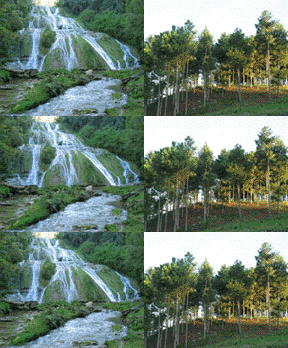
Then, the nearby spectacular beaches and beautiful waterfalls of the region are Jacmel's additional attractions. What about the sleek resorts nearby Jacmel's bay, they are an opportunity to indulge you in fantasies.
Remember that the city was once the refuge of Simon Jose Antonío Bolivar and Francisco de Miranda who were engaged in their struggle for the liberation of Latin America. And here was created the flag of Venezuela, a symbolic inspiration from the Haitian flag.